

Case Study 03 · Design Systems & AI
Building systems — and teaching AI to build them
For two decades, design systems have been my through-line. When the AI wave hit, everyone was chasing the same thing: fast, polished, interactive prototypes. They won early greenlights for my strategic proposals, too. But I looked under the hood: the plumbing was poor, and AI couldn’t map to systems. That’s what pushed me past the demo — to build and train the tooling that teaches AI to write quality, systematic code. This is both stories, in order: the systems I built at growing scale, and the machine I taught to build them.
Systems → AI
Two decades of building systems — and Alfred, the tool I built and trained to make AI build them right
Design systems at ecosystem scale, and the AI tooling that writes production-quality, systematic code — because good code isn’t subjective, and I know exactly how to specify it.
Outcome
The AI-assisted tooling and page-builders I built turn the design system’s structured docs and my own MD rule files into system-consistent generated code and faster prototypes — speeding delivery and lifting the team’s output on their protected growth time.
At a glance
Role
Strategic design leader and people manager — led Design Systems for Fire TV and Fire Tablet with design leads across the space, including 3P manufacturer HIG & customization support; and, with the AI tooling I built, building production code myself again
Scope
Design systems at ecosystem scale, plus the AI tooling that generates systematic, production-quality code
Also leading
Concurrently led the Amazon Appstore — the consumer storefront and the Amazon Developer platform — including its brand & marketing
Skills
Design-systems architecture · Governance · Front-end & AI tooling · Mentorship · Strategy · Stakeholder alignment · People management
A note on the through-line
From four Alexa device systems in 2022, to growing the next systems leaders, to enabling 130 third-party manufacturers in 2026 — and, when AI arrived, building the tool that finally makes it write production-quality code. One through-line, at ever-larger scale: systems. I’ve led them from both sides — as the developer who built them and the designer who governs them.
It started with an interactive-design degree, bridging design and code in Flash and ActionScript. When Flash was deprecated, that naturally moved me into front-end development — the era of responsive design and the first big frameworks, Bootstrap and jQuery. But I was already focused on lean, high-performance code and architecture, so I built my own component libraries and systems instead — before “design systems” was even a term. At Goldman Sachs I was hired to re-architect their wealth-management platform and build its component library — and it was my agile and scrum-master background that got both designers and developers to actually adopt it. By Chase, and then Amazon — one of the largest design orgs in the Amazon organization — I was strictly on the design side of governance, but always partnered closely with the systems-engineering teams. My role is strategy, architecture, and mentoring — setting the direction, governing the systems, and growing the teams who build them. Knowing both sides — the code and the design — is precisely what lets me teach AI to write good code and hold the bar.
2022 · Head of Design Systems, Alexa Devices
Four device systems, one atomic backbone
I led design systems for four device orgs — Fire TV, Echo, Fire Tablet, and Alexa Mobile — and turned a cleanup-and-spec team into system designers with real governance.
The problem I inherited
A cleanup team, not a systems team
The team was mostly doing production cleanup and writing dense spec docs — deeply technical, but not operating as system designers with governance. And the files fought them: 20–30 screen UX files with no grid and no auto-layout, so fixing one screen meant fixing all of them by hand.
The fix
An atomic architecture
I rebuilt the libraries on an atomic model — tokens → foundation → elements → patterns → templates — so a change propagates instead of being re-drawn everywhere, and so the team designs the system rather than cleaning up after it.
The library, and the 2022 arc
-
Build
Atomic libraries across four devices
Foundation to templates, per device — Mobile, Tablet, Echo, and Fire TV each getting a real, governed system.
-
Migrate
Sketch → Figma, rebuilt atomically
The org was on Sketch. To build a mature library I moved everyone to Figma, rebuilding every library atomically — each one by hand, from the ground up. Within a year we published a mature library.
-
Partner
An Echo-led unified strategy
I partnered with the Echo-sponsored team writing a unified-system strategy across devices; a couple of my designers helped build their library too.
-
Call it
Fire TV builds its own
I questioned the premise: Fire TV is a 10-foot, remote-driven screen — does it really unify with small touch devices? The team needed a system now, so we committed to Fire TV’s own.
-
Deliver · Alexa HIG
The published Alexa guidelines
The unified thread led to the public Alexa Human Interface Guidelines at developer.amazon.com/alexa — which I helped consult, design, and deliver as part of the team. (Shown in the hero above.)
What the 2022 systems work delivered
Delivered
Component libraries · 4 devices
Built governed, atomic systems across the Alexa device family — Mobile, Tablet, Echo, and Fire TV.
Delivered
Sketch → Figma
Migrated the whole org, with the design-ops and training to make it stick.
Published
The first Alexa HIG
Internal and external guidelines — the one public artifact here.
The full journey
AI & Systems — the full journey
The full journey, shown with examples — available on request: Head of UX & mentorship at the Appstore; 1P/2P/3P enablement at ecosystem scale (130 manufacturers); and the AI journey — teaching AI to build on systems, the POCs, Alfred, the quality thesis, and the Fire TV refactor. Reach out for access. View more of my journey with examples →
Enablement & the AI journey
First-, second-, and third-party enablement at scale — and teaching AI to build on systems: the tooling, the POCs, and the quality thesis.
Now · Fire TV, refactored
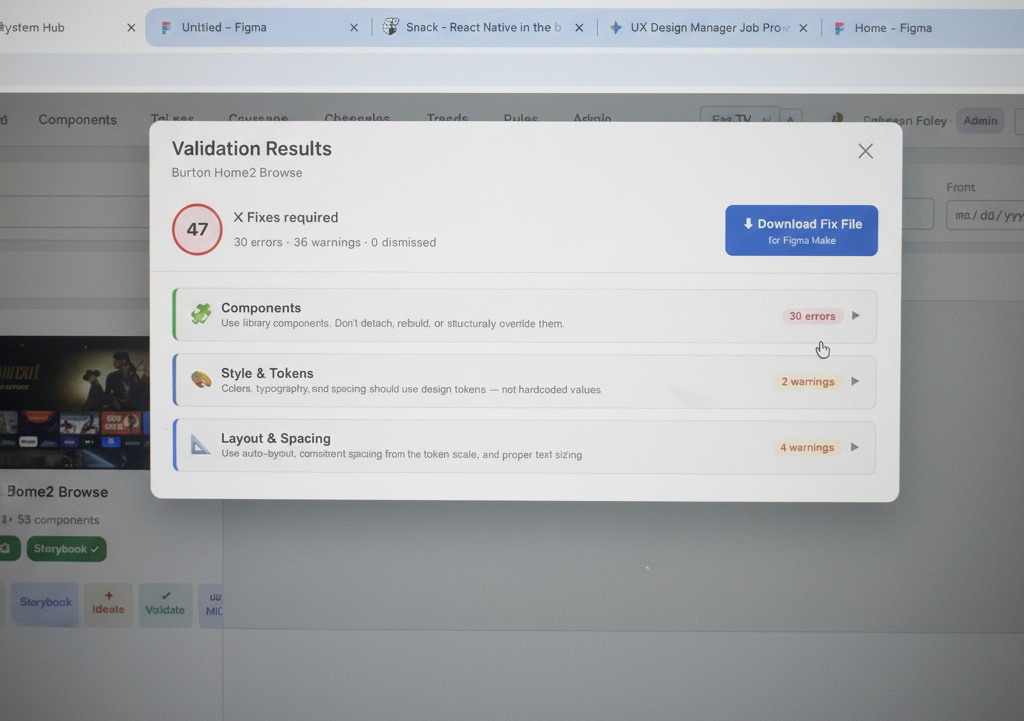
Back in systems ownership, rebuilding Fire TV ground-up — built for humans and for AI.
Design Ops
How design collaborates with the business — the operating model and good practices I built or recommend for strategic thinking, agile processes, and design-thinking workshops.
Design Systems
The human-interface guidelines (HIGs) I built for design systems — the standards and governance behind the components.